
Perch tracks which windows the user focuses and keeps two short lists: recent, and most used today. The apps scope reads them and launches from them; it never executes arbitrary paths.
| Scope | Installs |
|---|---|
apps | perch.apps.read(), perch.apps.launch(entry), perch.apps.focused(), perch.apps.on_focus_change, perch.apps.configure(options) |
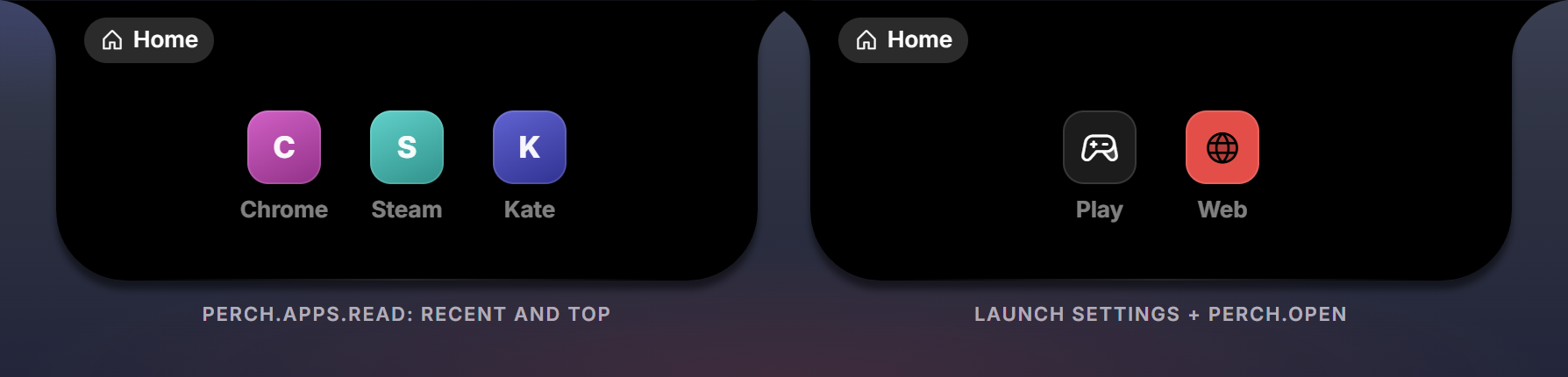
perch.apps.read
perch.apps.read(): app_lists_t{ recent, top }, each up to 6 entries. Synchronous. The lists have no signal; poll while your page is visible.
perch.apps.launch
perch.apps.launch(entry: app_entry_t): ()Launches an entry that came from read(). A table that did not raises perch.apps.launch(entry): pass an entry from perch.apps.read(). In a repeater the tap’s ctx.index picks the entry out of the last read:
--!strict
type app_refs_t = { icon: field_ref_t<string>, name: field_ref_t<string> }
local recent: { app_entry_t } = {}

local function launch(ctx: input_context_t)
  local entry = recent[ctx.index or 1]
  if entry then perch.apps.launch(entry) end
end

-- in the tree
ui.list { items = f.apps, max = 5, gap = 8,
  item = function(it: app_refs_t): node_t
    return ui.column { w = 66, on_click = launch,
      ui.image { src = it.icon, w = 42, h = 42, hover = ui.hover.lift },
      ui.text { text = it.name, size = 12 },
    }
  end }

-- in logic
local function refresh()
  recent = perch.apps.read().recent
  local rows = {}
  for i, e in ipairs(recent) do rows[i] = { icon = e.icon or "", name = e.name } end
  dock:push({ apps = rows })
end
perch.apps.focused
perch.apps.focused(): focused_app_t?
perch.apps.on_focus_change: signal_t<focused_app_t>
The application in the foreground right now, or nil when Perch cannot tell; and the signal that fires whenever it changes, regardless of the tracking option. ref is the launch reference perch.open.app accepts.
perch.apps.configure
perch.apps.configure(options: apps_options_t): ()How the builtin Apps package applies its settings page. tracking = false stops tracking and wipes the store; exclude lists programs to leave out, as settings.launch values, matched by executable name.
Types
export type app_entry_t = { name: string, sub: string?, icon: string?, ref: string }
export type app_lists_t = { recent: { app_entry_t }, top: { app_entry_t } }| Field | Meaning |
|---|---|
name | the program’s display name |
sub | recent: "just now", "3m ago", "2h ago"; top: "14m today", "1.5h today"; "" under a minute |
icon | a file:// URL of the extracted icon, or "" |
ref | the launch reference |
export type focused_app_t = { app_id: string, name: string, ref: string }
export type apps_options_t = { tracking: boolean?, exclude: { { target: launch_target_t? } }? }
The foreground application, and the argument of configure.